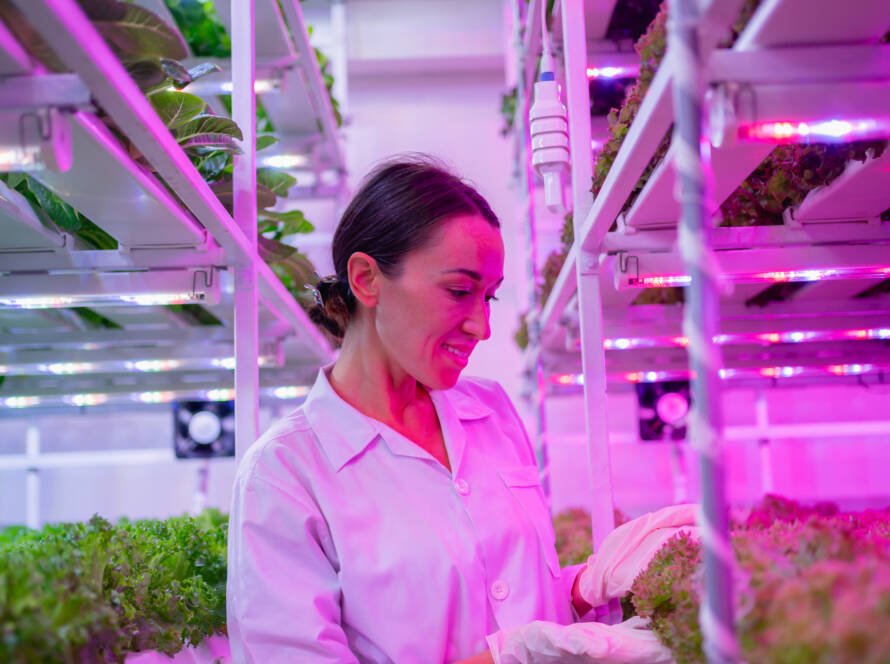
1. Hydroponics: Farming Without Soil
Hydroponics grows plants in nutrient-rich water instead of soil. The system delivers minerals directly to the roots through a solution that circulates continuously.
How It Works
- Roots are placed in water mixed with nutrients.
- Pumps and sensors manage oxygen, pH, and nutrient levels.
- Systems such as Nutrient Film Technique (NFT) or Deep Water Culture (DWC) keep roots moist and nourished.
Advantages
- Uses up to 90% less water than soil farming.
- Grows crops year-round in any location.
- Prevents weeds and soil-borne pests.
- Delivers faster growth and higher yields.
Challenges
- Requires power and constant monitoring.
- Initial setup cost is higher than traditional farming.
Common Crops: Lettuce, basil, spinach, tomatoes, strawberries, and herbs.
2. Aeroponics: Plants Growing in Air
Aeroponics uses a fine mist to deliver nutrients to plant roots suspended in the air. This method increases oxygen access and accelerates plant growth.
How It Works
- Plants are held in frames with roots exposed to air.
- Misters spray nutrient-rich water at set intervals.
- Sensors maintain humidity and nutrient balance.
Advantages
- Uses 95% less water than soil farming.
- Provides better oxygen absorption for faster growth.
- Reduces disease risk since no soil is used.
Challenges
- Mist nozzles can clog.
- Power loss or system failure quickly harms plants.
Best For: Leafy greens, herbs, strawberries, and seedlings.
3. Aquaponics: Fish and Plants Together
Aquaponics combines fish farming with hydroponics. Fish waste turns into natural fertilizer for plants, and plants clean the water for the fish.
How It Works
- Fish live in tanks and produce ammonia-rich waste.
- Bacteria convert waste into nitrates for plants.
- Plants absorb nutrients, and filtered water returns to the fish tank.
Advantages
- Produces vegetables and fish together.
- Uses minimal water.
- Creates a natural and balanced ecosystem.
Challenges
- Requires careful monitoring of pH and ammonia levels.
- Balancing fish and plant populations is essential.
Common Fish and Crops: Tilapia, catfish, trout, lettuce, kale, basil, and mint.
4. Indoor Farming: Controlled Growing Environments
Indoor farming uses enclosed spaces like greenhouses or warehouses to grow crops year-round. Technology controls light, temperature, and humidity.
How It Works
- Grow lights replace sunlight.
- Sensors and automation regulate conditions.
- Plants grow in hydroponic or aeroponic systems.
Advantages
- Continuous production, unaffected by weather.
- No pests or soil contamination.
- Suitable for urban and small spaces.
Challenges
- High energy use for lighting and climate control.
- Setup and maintenance costs can be high.
Best Crops: Herbs, microgreens, leafy greens, and mushrooms.
5. Vertical Farming: Growing Upward
Vertical farming stacks plants in layers, maximizing space and yield in small areas. This system uses hydroponic or aeroponic methods with LED lighting.
How It Works
- Multiple growing layers are built vertically.
- Lights and nutrients are distributed evenly.
- Automation manages airflow, water, and light cycles.
Advantages
- Grows food in limited space.
- Uses 70–95% less water.
- Reduces transport costs by producing food near cities.
Challenges
- Energy costs for lighting are significant.
- Suitable mainly for small crops.
Best Crops: Lettuce, kale, herbs, and strawberries.
6. Emerging Systems in Alternative Farming
Container Farming
Modified shipping containers serve as compact farms equipped with hydroponics and LED lights. They are mobile and suitable for urban areas or harsh climates.
Smart Farming
Uses artificial intelligence, sensors, and data analytics to optimize watering, lighting, and nutrients. This reduces waste and improves efficiency.
Organic Indoor Farming
Combines organic fertilizers and pest control with indoor growing systems for chemical-free produce.
7. Why Alternative Farming Matters
The Food and Agriculture Organization (FAO) projects that global food demand will increase by 50% by 2050. Yet farmland and freshwater are shrinking. Alternative farming offers a practical solution.
Key Benefits:
- Conserves land and water.
- Produces food closer to cities.
- Cuts transport emissions.
- Reduces pesticide use.
- Provides steady year-round harvests.
Studies by NASA show that hydroponic and vertical farming can produce up to 15 times more food per square meter than traditional methods.
8. Frequently Asked Questions
Q1: Is hydroponic food safe to eat?
Yes. Nutrients come from clean mineral solutions, and plants are free from soil contaminants.
Q2: Can alternative farming work in poor regions?
Yes. Solar-powered systems and low-cost materials make small-scale setups affordable.
Q3: Is aquaponics more sustainable than hydroponics?
Aquaponics recycles fish waste naturally, but it requires more management.
Q4: How much space does vertical farming need?
A small warehouse can supply hundreds of households with fresh greens.
Q5: What is the biggest challenge?
Energy use and high initial setup costs are the main challenges.
Q6: Can farmers switch easily to alternative methods?
Yes, but training and technical knowledge are required for success.
Q7: Do these methods use chemicals?
No. Most systems rely on controlled environments that reduce or eliminate pesticide use.
9. The Future of Alternative Farming
As global demand for sustainable food increases, alternative farming will continue to expand. Integration with renewable energy and automation will make these systems more affordable.
Urban areas will rely on vertical and container farms to supply fresh, local food. Traditional farmers may adopt hybrid systems that combine soil and hydroponic techniques for efficiency.
Governments and research institutions are already funding innovation in smart agriculture, water recycling, and low-cost energy solutions to support this transition.
Final Thoughts
Alternative farming is not a distant idea—it is happening now. Hydroponics, aeroponics, aquaponics, indoor, and vertical farming show that growing food can be clean, efficient, and local.
As technology advances, anyone can grow fresh produce anywhere—whether in a city, a desert, or even space. These systems point to a future where food production is sustainable, secure, and within everyone’s reach.
References: