

The Tower Power: How Vertical Stacking Doubles Your Yield
Direct Answer: Yes, vertical stacking genuinely multiplies your harvest, and the gains are actually much bigger than just doubling. Home tower gardens can realistically produce 2-4 times more food per square foot than traditional flat gardens, while commercial vertical farms achieve 10 to 20 times more yield per acre according to USDA research. The secret lies in growing upward instead of outward, stacking multiple growing levels to maximize every cubic inch of space.
For families working with limited space, whether it's a small patio, a corner of the garage, or a sunny kitchen wall, vertical farming transforms a tiny footprint into a surprisingly productive food source. Let's dig into exactly how this works and why physics is on your side.
Why Growing Up Beats Growing Out
Traditional gardening spreads plants across a flat plane. One tomato plant takes up one square foot of ground space. Simple math, right?
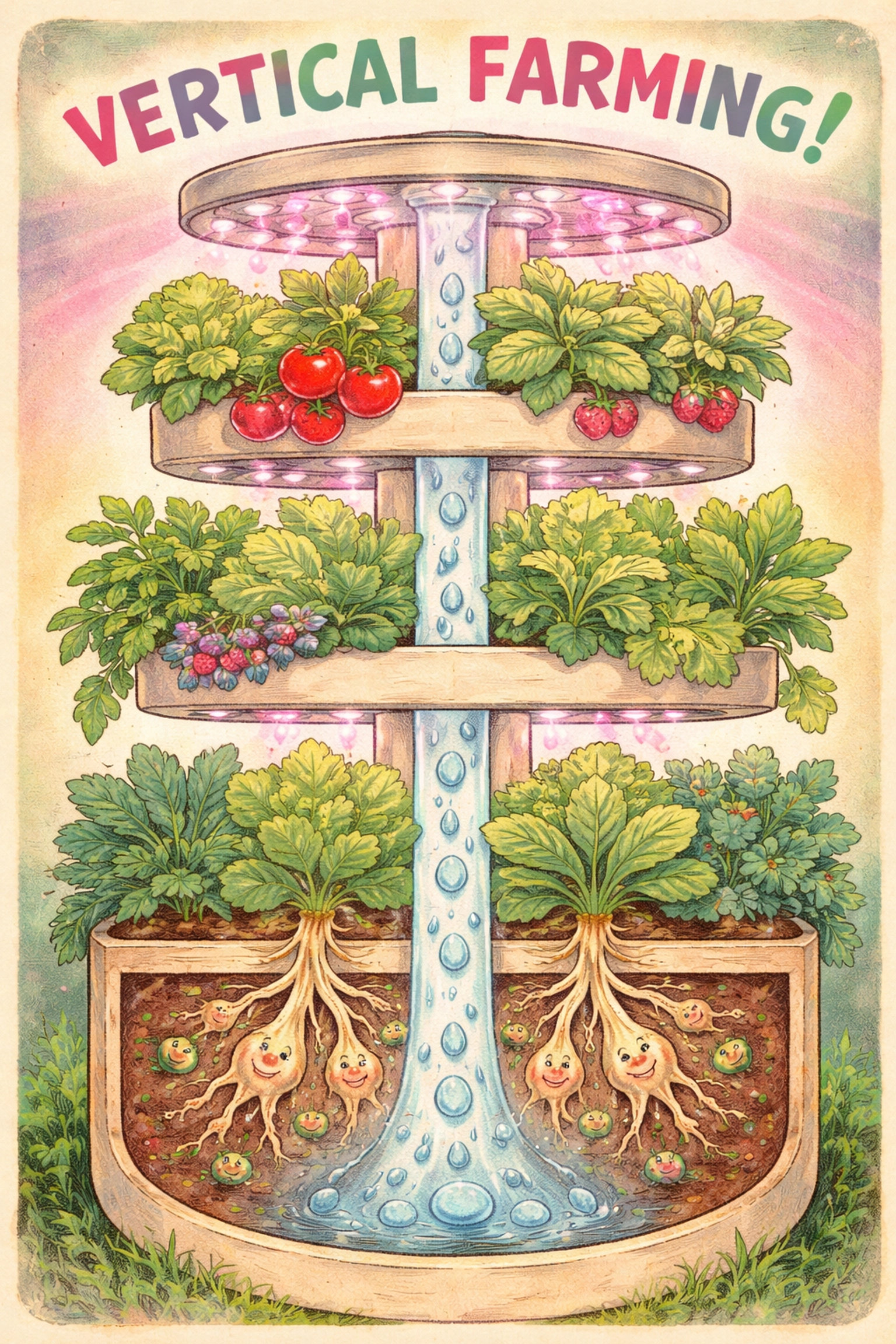
Vertical farming flips this equation by stacking growing levels on top of each other. Instead of one growing surface, you might have four, six, or even ten layers occupying the same floor footprint. A single square foot of floor space suddenly supports multiple plants growing at different heights.

This isn't just clever organization, it's a fundamental shift in how we think about growing area. Commercial vertical farms take this concept to extremes, achieving yields that would require 40 acres of traditional farmland from just one acre of vertical space. Research has documented systems producing 13.8 times more crop per unit of floor area compared to conventional horizontal setups.
The Science Behind Stacked Success
Three key factors combine to create vertical farming's yield advantage:
1. Spatial Density
Every cubic inch matters in a vertical system. Plants grow in stacked trays, tower pockets, or tiered shelving units. Where a traditional raised bed might hold 16 lettuce plants per square foot of ground, a four-tier vertical system in that same footprint could hold 64 plants.
2. Controlled Growing Conditions
Indoor vertical setups let you control light, temperature, water, and nutrients with precision. Plants aren't waiting for ideal weather, they're getting ideal conditions every single day. This means faster growth cycles and more harvests per year.
3. Year-Round Production
Outdoor gardens in most climates produce for maybe 4-6 months. An indoor vertical farm produces 12 months a year. Even if your per-harvest yield stayed the same (it won't, it'll increase), tripling your growing season automatically triples your annual harvest.
Real Numbers: What Can You Actually Expect?
Let's talk realistic expectations for different scales:
Home Tower Garden (4-6 feet tall, 20-30 plant sites):
- Floor footprint: About 2 square feet
- Potential yield: 200+ heads of lettuce per year, or equivalent leafy greens
- Comparison: A traditional 2-square-foot garden bed might produce 30-40 heads annually
Small Indoor Vertical Shelf System (4 tiers, grow lights):
- Floor footprint: About 8 square feet
- Potential yield: Equivalent to 25-30 square feet of outdoor garden space
- Year-round herbs, lettuce, and microgreens
Commercial Scale (for context):
- USDA research confirms 10-20 times the yield per acre for crops like lettuce and leafy greens
- Advanced systems with optimized lighting have documented yields up to 60-105 kg per square meter annually
- Some cutting-edge facilities report multipliers as high as 350 times traditional field farming for specific crops
The takeaway? Even modest home setups reliably double or triple your harvest. Go bigger and more optimized, and the multipliers get dramatic.
Building Your First Vertical System: A Family Project
Ready to test tower power yourself? Here's a straightforward approach families can tackle together:
The PVC Tower Method
Materials needed:
- 4-inch diameter PVC pipe (5-6 feet long)
- Net cups or small plant pots
- Small submersible pump
- Plastic reservoir bin
- Tubing
- Growing medium (clay pebbles or perlite)
- Hydroponic nutrients
Basic concept:
Drill 2-inch holes every 8-10 inches in a spiral pattern up the PVC pipe. Insert net cups holding seedlings and growing medium. A small pump circulates nutrient solution from the reservoir at the bottom up through the center of the tower, trickling down past each plant's roots.

This single tower occupies about one square foot of floor space but provides 15-20 growing sites, each producing a full plant. That's 15-20 times the yield per square foot compared to traditional soil planting.
Budget Breakdown: Tower Garden Costs
| Component | Budget Option | Mid-Range Option |
|---|---|---|
| PVC pipe or tower structure | $15-25 | $40-60 (commercial tower kit) |
| Submersible pump | $10-15 | $25-35 |
| Reservoir container | $8-12 (storage bin) | $20-30 (purpose-built) |
| Growing medium | $12-18 | $20-30 |
| Net cups (20-pack) | $6-10 | $10-15 |
| Tubing and fittings | $8-12 | $15-20 |
| Hydroponic nutrients (starter) | $12-20 | $25-40 |
| Grow lights (if indoor) | $30-50 | $80-150 |
| Total Startup | $100-160 | $235-380 |
Most families can get a functional tower garden running for under $150 using the budget approach. The mid-range option provides better durability and easier maintenance.

Best Crops for Vertical Tower Systems
Not every plant thrives in vertical setups. Focus on these proven performers:
Excellent choices:
- Lettuce and salad greens (fastest results, most reliable)
- Herbs: basil, cilantro, mint, parsley
- Spinach and Swiss chard
- Strawberries (a family favorite)
- Kale and arugula
Workable with care:
- Cherry tomatoes (need support and adequate lighting)
- Peppers (compact varieties)
- Green onions
Skip these for towers:
- Root vegetables (carrots, potatoes, beets)
- Large fruiting plants (full-size tomatoes, melons, squash)
- Corn or anything tall and top-heavy
Maintaining Your Vertical System
Tower gardens require different care than soil gardens:
Daily: Quick visual check of water flow and plant health
Weekly: Test pH levels (aim for 5.5-6.5), check nutrient concentration, inspect roots for health
Monthly: Deep clean reservoir, replace nutrient solution completely, trim any dead material
The trade-off is worth it: no weeding, no soil pests, no wondering if your plants got enough water while you were at work.
Frequently Asked Questions
How much faster do plants grow in vertical hydroponic towers?
Most leafy greens reach harvest size 30-50% faster than soil-grown equivalents due to optimal nutrient delivery and controlled conditions. Lettuce that takes 60 days in soil often matures in 35-45 days in a tower system.
Can vertical towers work without electricity?
Passive systems exist using gravity-fed wicking, but yields drop significantly without active water circulation. A small solar panel and battery can power a basic pump if electricity access is limited.
Do I need special seeds for vertical farming?
No. Standard seeds work perfectly. However, compact or "patio" varieties of larger plants perform better in the confined growing pockets.
How much does it cost to run a tower garden monthly?
A small pump uses about 3-8 watts: roughly $1-3 per month in electricity. Grow lights add more, typically $5-15 monthly depending on wattage and hours used. Nutrients run about $5-10 monthly for a home-scale system.
Is vertical farming actually sustainable?
Indoor vertical farms use 90-95% less water than traditional field farming due to recirculating systems. The energy question is more complex; LED lighting requires electricity, but eliminating transportation, pesticides, and seasonal limitations offers trade-offs worth considering.
References:
- USDA National Institute of Food and Agriculture, Vertical Farming Research Summary
- Comparative yield studies: vertical column systems vs. horizontal hydroponic methods
- Commercial vertical farming productivity data, peer-reviewed agricultural research