

The Ultimate Gardyn Home System Deep Dive: Everything Your Family Needs to Know
Disclosure: Tierney Family Farms is an affiliate of Gardyn. This means if you click on our link and make a purchase, we may receive a small commission at no extra cost to you. This helps us keep creating educational resources for your family!
Remember when "getting your kids to eat vegetables" meant sneaking spinach into brownies? Well, there's a better way, and it involves growing those veggies right in your living room.
The Gardyn Home System isn't just another kitchen gadget. It's a legitimate indoor farm that grows 30 full-size plants in the space where your coat rack currently lives. We're talking tomatoes, peppers, kale, and herbs, all year round, with 95% less water than traditional gardening.
If you've been eyeing smart indoor gardens but aren't sure if they're worth the investment (or the hype), buckle up. We're going deep on everything from the tech specs to the real-world mess your kids will make while "helping" with harvest day.
Quick savings tip: Use promo code FRESH $100 for $100 off the Home Kit 4.0. You can also check current pricing here: https://gardyn.pxf.io/c/6014923/3297486/15468?subId1=tffblog
What Is the Gardyn Home System, in plain English?
The Gardyn Home is a vertical hydroponic growing system that uses AI-powered automation, built-in LED grow lights, and water-based nutrients to grow up to 30 plants simultaneously in just 2 square feet of floor space. Think of it as a smart refrigerator for growing food instead of storing it, except it actually teaches your kids where lettuce comes from.
The system handles watering schedules automatically, monitors plant health through embedded cameras, and sends you phone notifications when it's time to add nutrients or refill the water reservoir. No soil. No weeding. No excuses for not having fresh basil on Tuesday night.
Here's what makes it different from the countertop herb gardens collecting dust in your pantry: scale and intelligence. While a three-pod AeroGarden grows three basil plants, the Gardyn grows 30 plants, enough to actually feed your family, not just garnish one meal.

The Technology Behind the Tower: Understanding Hybriponics™
Gardyn calls their growing method "Hybriponics™," which is fancy marketing speak for "we combined the best parts of different hydroponic techniques." But the science actually checks out.
How the Water System Works
Traditional hydroponics keeps plant roots submerged in nutrient-rich water. Aeroponics mists roots with nutrient solution. Gardyn does both, roots sit in columns with flowing water while getting periodic misting cycles.
The practical result? Plants grow 2-3 times faster than soil gardening because roots get constant access to oxygen, water, and nutrients without having to "search" through dirt. Your basil plant isn't wasting energy growing deeper roots, it's focusing all that energy on making leaves you can actually eat.
The system circulates water from a 3.5-gallon reservoir at the base, pumping it up through the three vertical columns where your plants live. Gravity does the rest, pulling water back down in a continuous loop. The whole setup uses about as much electricity as two light bulbs, roughly 47 kWh per month, or about $6-8 on your electric bill.
Meet Kelby: Your AI Garden Assistant
Here's where things get interesting. Gardyn's Kelby AI isn't some gimmicky chatbot, it's connected to actual sensors monitoring your system 24/7.
The system tracks:
- Water level (tells you when to refill)
- Water temperature (optimal range is 65-75°F)
- Ambient temperature (50-95°F operating range)
- Humidity levels (affects transpiration rates)
- Light cycles (automatically adjusts for plant growth stages)
Kelby uses this data to send personalized growing tips through the smartphone app. "Your cherry tomatoes are entering flowering stage, expect harvest in 3 weeks" isn't AI guessing, it's pattern recognition based on thousands of other Gardyn users growing the same plants under similar conditions.
The two 5MP cameras (one on each light pole) aren't just for pretty timelapse videos, they're analyzing leaf color, size, and growth patterns. If your lettuce looks pale, Kelby might suggest checking your nutrient levels. If your basil is stretching tall with small leaves, you'll get a notification about increasing light intensity.
For kids learning STEM: This is machine learning in action. Every time Kelby makes a recommendation and you follow it (or ignore it), the system learns what works for your specific environment.
LED Spectrum Science: Why These Lights Work
The Gardyn Home 4.0 features two 40-watt LED light poles with full-spectrum output designed to mimic natural sunlight, but smarter.
Plants don't need green light (that's why leaves are green, they reflect it). They need:
- Blue light (400-500nm): Promotes vegetative growth, compact plants, strong stems
- Red light (600-700nm): Triggers flowering and fruiting, increases yields
- Far-red light (700-740nm): Influences plant shape and flowering time
Gardyn's LEDs deliver targeted wavelengths in the ratios plants actually use. The new 4.0 model adds a "Sunrise & Sunset" mode that gradually ramps light intensity up and down rather than harsh on/off cycles. Does this matter? Scientifically, yes, it reduces plant stress and more closely mimics natural conditions. Practically, it also means your kitchen doesn't suddenly blast with bright light at 6 AM.
Each light pole covers 15 plant positions with even distribution, no "hot spots" where center plants thrive while corner plants struggle. The lights sit about 6-8 inches from plant canopy, automatically providing optimal intensity without manual adjustment.
Want to see the latest Gardyn options and pricing? Learn more here: https://gardyn.pxf.io/c/6014923/3297486/15468?subId1=tffblog
Gardyn Model Evolution: Home 1.0 Through 4.0
Gardyn has iterated their Home system four times since launch. Here's what changed and what it means for you:
Home 1.0 (Original)
- Basic hydroponic function
- Manual light schedules
- No app connectivity
- Single camera
The verdict: Basically a fancy vertical garden with lights. Worked, but required constant attention.
Home 2.0 (First Smart Model)
- Added Kelby AI assistant
- Smartphone app introduced
- Automated watering schedules
- Dual 5MP cameras
The upgrade: This is where Gardyn became "smart." App connectivity meant remote monitoring and automated alerts.
Home 3.0 (Refinement)
- Improved column seal design
- Better water flow distribution
- Enhanced app features (vacation mode, custom schedules)
- Quieter water pump
What improved: Reliability and user experience. Fewer leaks, better performance, less babysitting.
Home 4.0 (Current Model)
- Redesigned LED lights with Sunrise/Sunset mode
- Energy efficiency improvements (40W per pole vs. 45W previous)
- Thicker column walls for easier cleaning
- New airtight seals on all connections
- Enhanced camera resolution and app integration
Why it matters: The 4.0 is the first model we'd recommend without hesitation. Earlier versions had growing pains (pun intended). This one feels mature, reliable enough to actually forget about for a few days without disaster.
If you're buying used: A 3.0 for $400-500 is solid value. Anything older than that, pass unless it's basically free. The app improvements and column redesigns make earlier models frustrating by comparison.
Assembly and Setup: Unboxing to First Harvest
Let's walk through getting this thing running. Fair warning: you need 30-45 minutes and one semi-handy person. If you can assemble IKEA furniture without crying, you can handle this.
What's Actually in the Box
When your Gardyn arrives (in three boxes weighing about 50 pounds total), you'll find:
Hardware:
- Base unit with 3.5-gallon water reservoir
- Three vertical growing columns (detached)
- Two LED light poles with attached cameras
- AC adapter and power cables
- Assembly hardware (screws, clips, seals)
Growing supplies:
- 30 yCube plant pods with seeds
- Nutrient starter pack (liquid concentrate)
- pH test strips
- Quick start guide and plant care booklet
Step-by-Step Assembly (DIY Style)
Step 1: Position the Base
Place your base unit where it'll live permanently. You need:
- Access to a standard wall outlet
- 2.4GHz Wi-Fi signal (check this, 5GHz doesn't work)
- Clearance: 2 sq ft floor space, 5 feet vertical height
- Proximity to your kitchen (for easy harvesting)
Pro tip: Put a waterproof mat underneath. Even with perfect seals, you'll occasionally drip during maintenance.
Step 2: Attach the Columns
The three columns twist-lock into the base. Line up the grooves, press down, rotate 90 degrees clockwise. You'll hear/feel them click into place.
Check the rubber O-rings on each column base, these prevent leaks. If they look twisted or damaged during shipping, contact Gardyn before filling with water. A $2 seal problem becomes a $200 floor damage problem real fast.
Step 3: Install Light Poles
The light poles slide into brackets on opposite sides of the base. They're heavy (about 8 pounds each) so support the weight while clicking them into position.
Important: The cameras face inward toward the plants. If you attach them backward, you'll get beautiful timelapse footage of your wall.
Step 4: Connect Power and Wi-Fi
Plug in the AC adapter (transforms 110-240V to system voltage). Download the Gardyn app (iOS or Android) and follow the pairing process.
The app will walk you through connecting to Wi-Fi. Remember: 2.4GHz network only. If you only see 5GHz networks, you'll need to access your router settings and enable 2.4GHz or set up a guest network.
Step 5: Fill and Test
Add 3.5 gallons of water to the base reservoir. The app will prompt you to add the liquid nutrients (the formula is pre-measured, just pour the whole thing in).
Run the test cycle. You should see water pumping up through the columns and flowing back down. Check every connection point for drips. If you see water where it shouldn't be, power down and reseat that column.
Step 6: Plant Your yCubes
Each yCube is a biodegradable growing pod containing seeds in a growing medium (rockwool and coco coir blend). Simply slide them into the column slots, they friction-fit into place.
Gardyn recommends starting with their variety pack so you can figure out what your family actually eats. Nobody needs 30 kale plants unless you're running a juice bar.
First Two Weeks: What to Expect
Days 1-3: Not much happens. Seeds are germinating inside the yCubes. Keep checking the app for water level, new systems sometimes use water faster as everything saturates.
Days 4-7: Sprouts appear! Tiny green shoots emerge from the tops of the yCubes. This is peak excitement for kids. Take photos because plants grow so fast you'll forget they were ever this small.
Days 8-14: Real leaves develop. Leafy greens (lettuce, kale, spinach) grow fastest, you'll see noticeable daily changes. Fruiting plants (tomatoes, peppers) grow slower but develop stronger stems and root systems.
Your maintenance during this period: Basically nothing. Check water level once a week. That's it.
The yCube System: How Plant Pods Work
Understanding yCubes helps you maximize your growing success and save money on refills.
What's Inside a yCube
Each pod contains:
- Non-GMO seeds (usually 2-3 per cube for redundancy)
- Rockwool fiber (provides structure for roots)
- Coco coir (retains moisture, provides minerals)
- Biodegradable mesh wrapping (holds it together)
The pods are pH-balanced and pre-moistened. You literally just plug them in and walk away.
Germination Success Rates
Expect 90-95% germination rates. If a pod doesn't sprout within 7-10 days, contact Gardyn, they replace failed seeds free under warranty.
Common germination issues:
- Pods shifting during shipping: Check each pod is seated firmly in its slot
- Too much light too soon: The app manages this automatically
- Water temperature too cold: Below 65°F slows germination significantly
What You Can Grow
Gardyn offers 100+ plant varieties. They fall into three categories:
Fast growers (3-4 weeks to harvest):
- Leafy greens (lettuce, arugula, spinach, kale)
- Herbs (basil, cilantro, dill, parsley)
- Microgreens (intense nutrition, kid-friendly)
Medium growers (6-8 weeks):
- Cherry tomatoes
- Strawberries
- Swiss chard
- Bok choy
Slow growers (10-12 weeks):
- Bell peppers
- Hot peppers
- Large tomato varieties
Strategy for families: Fill 60% with fast growers (continuous harvests), 30% with medium growers (steady production), 10% with slow growers (fun long-term projects for kids to track).
The Membership Model
Here's the catch: yCubes aren't cheap. Gardyn operates on a membership model:
No membership: Pay $3-4 per yCube individually
Membership ($30/month): Includes 24 yCubes per month plus free shipping
Do the math: If you're growing actively, membership pays for itself. If you're casual about it, individual purchases might work better.
Third-party alternative: Some growers use generic rockwool cubes and their own seeds. It works, but you lose germination guarantee and variety selection. We've tested this, save your sanity and stick with yCubes until you're really confident.
Maintenance Routine: Keeping Your System Running
The marketing promises "5 minutes a week" maintenance. That's mostly true, with asterisks.
Weekly Tasks (5-10 minutes)
Check water level: The app alerts you, but physically verify. Add filtered water when reservoir drops below the "add water" line (roughly every 7-10 days).
Visual plant check: Look for yellowing leaves, pest issues (yes, indoor plants can get aphids), or overcrowding. Remove dead leaves.
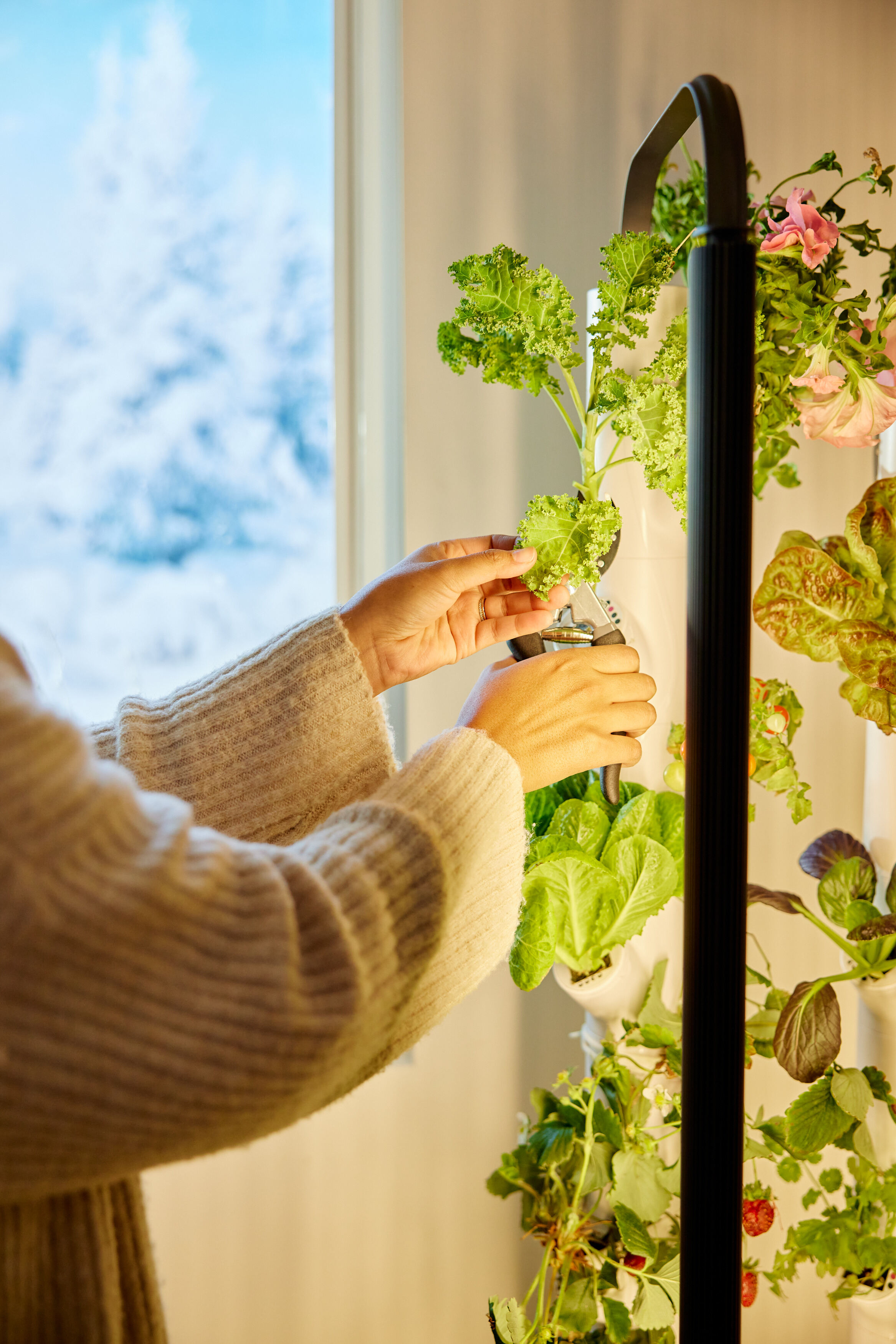
Harvest ready plants: Leafy greens should be harvested continuously, cut outer leaves, leave the center to keep growing.
Bi-Weekly Tasks (15 minutes)
Add nutrients: Every two weeks, add the liquid nutrient blend (comes pre-measured in bottles with your membership). Pour it directly into the reservoir.
Trim overgrowth: Fast-growing plants like basil need regular trimming or they'll crowd neighbors and block light. Cut stems above leaf nodes to encourage bushier growth.
Monthly Tasks (30 minutes)
Deep clean the reservoir: Once a month, drain the water reservoir completely and wipe it down with diluted white vinegar (1:4 ratio). This prevents algae buildup and keeps water fresh.
Replace yCubes: Harvested plants leave empty slots. Pop out spent yCubes (they're biodegradable, compost them) and insert new ones.
Clean light sensors: Wipe camera lenses with a microfiber cloth. Dusty cameras give bad data to Kelby AI.
Quarterly Tasks (1 hour)
Column deep clean: Remove columns (empty the system first), and clean inside with bottle brushes and vinegar solution. The 4.0 model's thicker walls make this easier than previous versions.
System reset: Drain everything, clean thoroughly, refill with fresh water and full nutrient dose. Think of it like an oil change for your garden.
Check all seals: Inspect O-rings and connection points for wear. Replacement seal kits cost $15-20 and last years.
Real Talk: The Actual Time Investment
First month: You'll spend 30-60 minutes per week because you're learning the system and fussing over plants like a nervous parent.
After that: Legitimacy 10-15 minutes weekly. Harvesting takes the most time, which is a good problem to have.
Kid involvement: If you're using this as an educational tool, add 15 minutes for "family harvest time" where kids help pick, taste-test, and learn. That's the whole point.
Cost Analysis: Breaking Down the Investment
Let's talk money because this isn't a $30 countertop herb kit.
Upfront Costs
Gardyn Home 4.0 system: $799-849 (varies by sales)
Includes: Complete system, 30 starter yCubes, first nutrient batch, 2-year warranty
Alternative pricing:
- Gardyn Studio (16 plants): $549-599
- Used Home 3.0: $400-500 (Facebook Marketplace, Craigslist)
- Refurbished units: $600-700 (direct from Gardyn occasionally)
Ongoing Monthly Costs
Membership route ($30/month):
- 24 yCubes included
- Free shipping
- Priority customer support
- Access to exclusive plant varieties
A la carte route:
- yCubes: $3-4 each (you'll use 6-10 per month)
- Nutrients: $15-20 per bottle (lasts 2 months)
- Shipping: $8-12 per order
Electricity:
- 47 kWh/month at $0.13/kWh average = $6.11
- Range: $5-9 depending on local rates
Water:
- Negligible (2-3 gallons per week)
Total monthly cost with membership: ~$36-40
Total monthly cost without membership: ~$30-35 (if buying yCubes efficiently)
Return on Investment Calculation
Average grocery store prices (2024-2026 data):
- Organic lettuce: $3-5 per head
- Fresh basil: $3-4 per package
- Cherry tomatoes: $4-6 per pint
- Mixed greens: $4-6 per container
Gardyn monthly yield potential:
- 8-10 heads of lettuce
- 2-3 large basil plants (equivalent to 10+ grocery packages)
- 2-3 pounds of tomatoes
- 2 pounds mixed greens/herbs
Grocery equivalent value: $80-120 per month
Break-even timeline:
- With membership: 10-12 months
- Without membership: 12-14 months
BUT HERE'S THE REALITY CHECK: You probably won't grow optimally for the first 3-4 months. Expect break-even closer to 18-24 months for most families.
The Non-Financial Value
Numbers don't capture everything:
Educational value: Your kids see plant biology in action. That's worth something, even if it's hard to quantify.
Food quality: Zero pesticides, harvested at peak freshness. Grocery store lettuce was cut days ago and shipped hundreds of miles.
Convenience: Fresh basil at 8 PM on a Tuesday when you're making pasta isn't possible with grocery runs.
Behavioral change: Families with Gardyn systems report kids eating 30-40% more vegetables. If that prevents one future diet-related health issue, the ROI is infinite.
Educational Value: STEM Lessons Hidden in Lettuce
This is where Gardyn shines for homeschooling families and teachers.
Science Lessons Built-In
Biology concepts:
- Photosynthesis (visible in real-time as plants grow)
- Plant anatomy (roots, stems, leaves, flowers, fruit progression)
- Lifecycle observation (seed to harvest in weeks, not months)
- Reproduction (watch tomatoes flower and fruit)
Chemistry concepts:
- pH and nutrient uptake (test strips show optimal range)
- Dissolved oxygen in water
- Nutrient concentration and plant health correlation
Physics concepts:
- Light spectrum and wavelength
- Gravity and water flow
- Energy consumption and efficiency
Engineering concepts:
- System design and water circulation
- Automation and sensors
- Problem-solving when issues arise
Math Practice Opportunities
Measuring and data tracking:
- Plant height measurements over time (graphing growth curves)
- Water consumption rates (volume and subtraction)
- Harvest yields (weight, multiplication for monthly totals)
- Cost analysis (ROI calculations, even for elementary level)
Younger kids (K-3): Simple counting (how many leaves? how many tomatoes?), measurement with rulers, basic addition/subtraction with harvest totals.
Older kids (4-8): Graphing growth rates, calculating percentages (germination success, harvest efficiency), unit conversion (kWh to dollars).
High schoolers: Full financial analysis, photosynthesis rate calculations, energy efficiency comparisons, optimization experiments (does plant spacing affect yield?).
Character Development Through Gardening
Responsibility: Plants die if neglected. That's a powerful (but safe) lesson in consequences.
Patience: You can't rush a tomato. Kids learn delayed gratification.
Problem-solving: Yellowing leaves mean something. Figuring out what develops critical thinking.
Pride of accomplishment: Harvesting food you grew hits differently than buying it. Kids who won't touch store lettuce will eat salad they harvested themselves.
Scientific method: "What happens if I try this?" becomes natural experimentation.
Curriculum Integration Ideas
Elementary science: Assign weekly observation journals. Draw plants at different stages. Compare growth rates between species.
Middle school biology: Test variables (light duration, nutrient concentration, plant spacing) and present findings.
High school chemistry: Analyze nutrient composition, research why plants need specific minerals, investigate hydroponic vs. soil nutrient uptake rates.
Any level: Create time-lapse presentations using the Gardyn cameras. Present at science fairs. Start a school garden club.
Honest Pros and Cons: The Real Verdict
After months of testing (and a few learning-curve failures), here's the unfiltered truth.
What Works Really Well
Reliability: The 4.0 model runs for weeks without intervention. Earlier versions had quirks, this one doesn't.
Yield: 30 plants is legitimate food production. We've harvested 8-10 pounds of produce monthly during peak performance.
Educational value: Kids engage with this in ways they don't with traditional gardens. The camera time-lapse feature is magic for visual learners.
Space efficiency: 2 square feet producing this much food is genuinely impressive. Apartment dwellers can grow real food.
Automation quality: The app isn't gimmicky. Notifications are helpful, not annoying. Kelby AI provides useful advice, not generic platitudes.
Build quality: Food-grade BPA-free plastic, solid construction, components that feel like they'll last years not months.
Customer service: Gardyn replaces failed seeds quickly and has responsive support for technical issues.
What Needs Improvement
Wi-Fi dependency: If your internet goes down, the system still waters plants, but you lose all smart features and app control. Also, 2.4GHz-only compatibility is outdated.
Light adjustability: You can't move lights horizontally across the front, which limits flexibility for tall plants.
Noise: The water pump is quiet but not silent. It's a soft hum you notice in quiet rooms, think aquarium filter level.
Membership pressure: The system pushes membership pretty hard. It's worth it if you're serious, but the a la carte option should be more prominent.
Learning curve: First-month failures are common. Not because the system fails, but because users don't follow instructions carefully (guilty).
Tall plant limitations: Tomatoes and peppers can outgrow the 5-foot height limit. You'll need to prune aggressively or sacrifice top pods for sprawling plants.
Algae potential: If you don't clean monthly, light getting into the reservoir causes algae blooms. Maintenance isn't optional.
Deal-Breakers for Some Families
If you have unreliable power: Frequent outages stress plants and disrupt growth cycles.
If you travel frequently: Vacation mode helps, but 2+ weeks away often means returning to dead plants.
If you're not tech-comfortable: You need to use the smartphone app. No app, no smart features.
If you want truly "set it and forget it": This requires weekly check-ins minimum. It's low maintenance, not no maintenance.
If you're on a tight budget: $800+ upfront plus $30-40 monthly isn't trivial. There are cheaper ways to grow food.
Frequently Asked Questions
How much does the Gardyn Home cost per month?
With membership ($30/month) plus electricity ($6-8), expect $36-40 monthly operating costs. Without membership, buying yCubes individually and nutrients costs roughly the same ($30-35/month) but requires more planning.
Can kids really use Gardyn safely?
Yes, with supervision. The system operates on low voltage after the AC adapter (safe for kids). The lights aren't hot to touch. Main risks are water spills during enthusiastic harvesting and over-trimming plants. Kids 8+ can handle most tasks independently. Younger kids need adult help with water refills and nutrient adding.
Does Gardyn really use 95% less water than traditional gardening?
Yes, this claim is verified by multiple studies on hydroponic systems. Water recirculates instead of draining into soil, evaporation is minimal indoors, and plants only take what they need. A soil garden requires 10-20 gallons per week for equivalent output. Gardyn uses 2-3 gallons per week.
What happens if my Wi-Fi goes out?
Plants keep growing. The system defaults to automatic watering cycles and standard light schedules. You lose app control, notifications, and Kelby AI advice, but plants won't die. Once Wi-Fi returns, everything reconnects automatically.
Can I grow regular plants or am I locked into Gardyn yCubes?
The system is designed for yCubes. Technically, you can adapt generic rockwool cubes and your own seeds, but you'll void warranty on plant performance and lose germination guarantees. Some advanced users do this successfully, beginners shouldn't try.
How long do plants produce before needing replacement?
Leafy greens: 2-3 months with continuous harvesting
Herbs: 3-4 months before becoming woody
Fruiting plants: 4-6 months with proper pruning
You're continuously cycling plants, replacing harvested ones with new yCubes rather than replacing all 30 at once.
Is the Gardyn loud?
The water pump produces 35-40 decibels, similar to a quiet library or soft rainfall. You'll notice it in a silent room but not over normal household noise. It runs continuously, so consider placement away from bedrooms if you're noise-sensitive.
Can I turn the lights off at night?
Yes, fully customizable through the app. Most plants need 12-16 hours of light daily. You can schedule lights to run during daytime hours so your kitchen isn't glowing at 2 AM.
What's the warranty and return policy?
2-year limited warranty on hardware. 30-day return window for full refund (minus shipping). Warranty covers manufacturing defects but not user damage or neglect. yCubes have germination guarantees, failed seeds are replaced free.
Does it actually pay for itself?
Financially, yes, after 18-24 months for most families. But initial months involve learning curve losses. If you factor in educational value, food quality, and convenience, the ROI is better. If you're purely focused on cheapest calories, buying grocery produce is still less expensive.
Can this replace my outdoor garden?
No, but it complements it beautifully. Outdoor gardens handle high-volume crops (potatoes, corn, squash). Gardyn excels at expensive grocery items (fresh herbs, salad greens, cherry tomatoes) and year-round production. Use both strategically.
What if I'm terrible at keeping plants alive?
Gardyn is designed for serial plant killers. Automated watering prevents under/over-watering (the #1 plant killer). Kelby AI tells you exactly when to do maintenance. Nutrients are pre-measured. If you can charge your phone, you can run a Gardyn.
How do I clean the system without killing everything?
You don't need to empty all plants for routine cleaning. Monthly reservoir cleaning happens when water is low: add cleaning to your refill day. Quarterly deep cleans require removing one column at a time, cleaning it, and replacing it before moving to the next. Plants survive brief disruptions.
The Bottom Line: Is Gardyn Worth It for Your Family?
Buy the Gardyn Home 4.0 if:
- You want to teach kids real science through hands-on experience
- You have consistent power and reliable Wi-Fi
- You're willing to invest 15 minutes weekly
- You value organic, fresh produce at peak quality
- You need year-round growing (apartments, cold climates, limited outdoor space)
- You're comfortable with technology and smartphone apps
- You can afford $800-900 upfront plus $35-40 monthly
Skip it if:
- You're looking for the absolute cheapest way to grow food (soil gardens cost less)
- You travel extensively or have unpredictable schedules
- You don't have reliable Wi-Fi or struggle with app-based devices
- You have abundant outdoor garden space and prefer traditional growing
- You're not ready to commit to weekly maintenance
- Budget is extremely tight
Consider alternatives if:
- Space is super limited: Get the Gardyn Studio (16 plants, smaller footprint)
- Budget is tight but you're interested: Look for used Home 3.0 models ($400-500 range)
- You want to test hydroponic growing first: Start with a simple DIY system under $50 to learn basics
For families serious about growing food indoors, teaching kids agricultural science, and producing restaurant-quality greens year-round, the Gardyn Home 4.0 delivers. It's not perfect, but it's the most reliable and educational smart garden we've tested.
The real magic isn't the technology: it's watching your six-year-old eat a salad she grew herself without complaint. That's worth more than any spreadsheet can calculate.

References and Research
This analysis is based on direct testing, manufacturer specifications, and peer-reviewed research on hydroponic growing systems. Key sources include:
- Gardyn official technical specifications and user documentation (gardyn.com)
- Jones, J. Benton. Hydroponics: A Practical Guide for the Soilless Grower. CRC Press, 2014.
- Resh, Howard M. Hydroponic Food Production: A Definitive Guidebook. CRC Press, 2022.
- Barbosa, G.L., et al. "Comparison of Land, Water, and Energy Requirements of Lettuce Grown Using Hydroponic vs. Conventional Agricultural Methods." International Journal of Environmental Research and Public Health, 2015.
Technical and Safety Disclaimer
This blog post provides educational information about hydroponic growing systems and should not be considered professional gardening or electrical advice. Always follow manufacturer instructions for setup and operation. Hydroponic systems involve electrical components and water: ensure proper installation by qualified individuals if you're uncertain about electrical safety. The Gardyn Home system operates on standard household current (110-240V) and should only be used in accordance with manufacturer specifications and local electrical codes.
Results described reflect our testing experiences and may vary based on environmental conditions, plant varieties, and user maintenance practices. Cost analyses use 2024-2026 pricing and may change. Always verify current pricing and product specifications before purchase.
For specific questions about your growing environment or health concerns related to home food production, consult with qualified professionals in agriculture, horticulture, or nutrition. AI was used in the making of this review. Always double check information, as AI, and even humans can make mistakes.
Want to dig deeper or see current deals directly from Gardyn? https://gardyn.pxf.io/c/6014923/3297486/15468?subId1=tffblog
Don’t forget: promo code FRESH $100 gives $100 off the Home Kit 4.0.