



The paper towel color walk works through a process called capillary action. Water molecules are attracted to the tiny cellulose fibers in paper towels (adhesion) and also to each other (cohesion). These combined forces pull colored water upward through microscopic gaps in the paper towel, defying gravity until it eventually reaches another cup and mixes colors right before your child's eyes.
This experiment is one of those rare gems that looks like magic but teaches real science: and you likely have everything you need in your kitchen right now.
At a Glance
| Detail | What to Expect |
|---|---|
| Skill Age Range | 4–6 years old (with some adult help for younger kids) |
| Enjoyment Age Range | 3–9 years old |
| Setup Time | About 10 minutes |
| Observation Time | 1–2 hours for visible color mixing (sometimes longer depending on paper towel brand) |
| Budget | $0–$3 |
A note on timing: Some sources suggest this happens in 15–20 minutes, but in our experience, it can take considerably longer depending on your paper towel thickness and room temperature. Plan for 1–2 hours of observation time: you might be pleasantly surprised if it happens faster, but you won't be disappointed if it takes a while.
Materials List
| Material | Assumed Cost | Notes |
|---|---|---|
| Paper towels | $0–$1 | You likely have these already; thicker brands may work differently than thin ones |
| 7 clear cups or jars | $0–$1 | Mason jars, drinking glasses, or plastic cups work fine |
| Food coloring (red, yellow, blue) | $0–$3 | A basic set from the grocery store; you may already have this in your pantry |
| Water | $0 | Tap water works perfectly |
| Optional: a tray or baking sheet | $0 | Helpful for containing spills |
Total estimated cost: $0 if you have the basics on hand, up to about $3 if you need to pick up food coloring.
Step-by-Step Instructions
Step 1: Arrange Your Cups
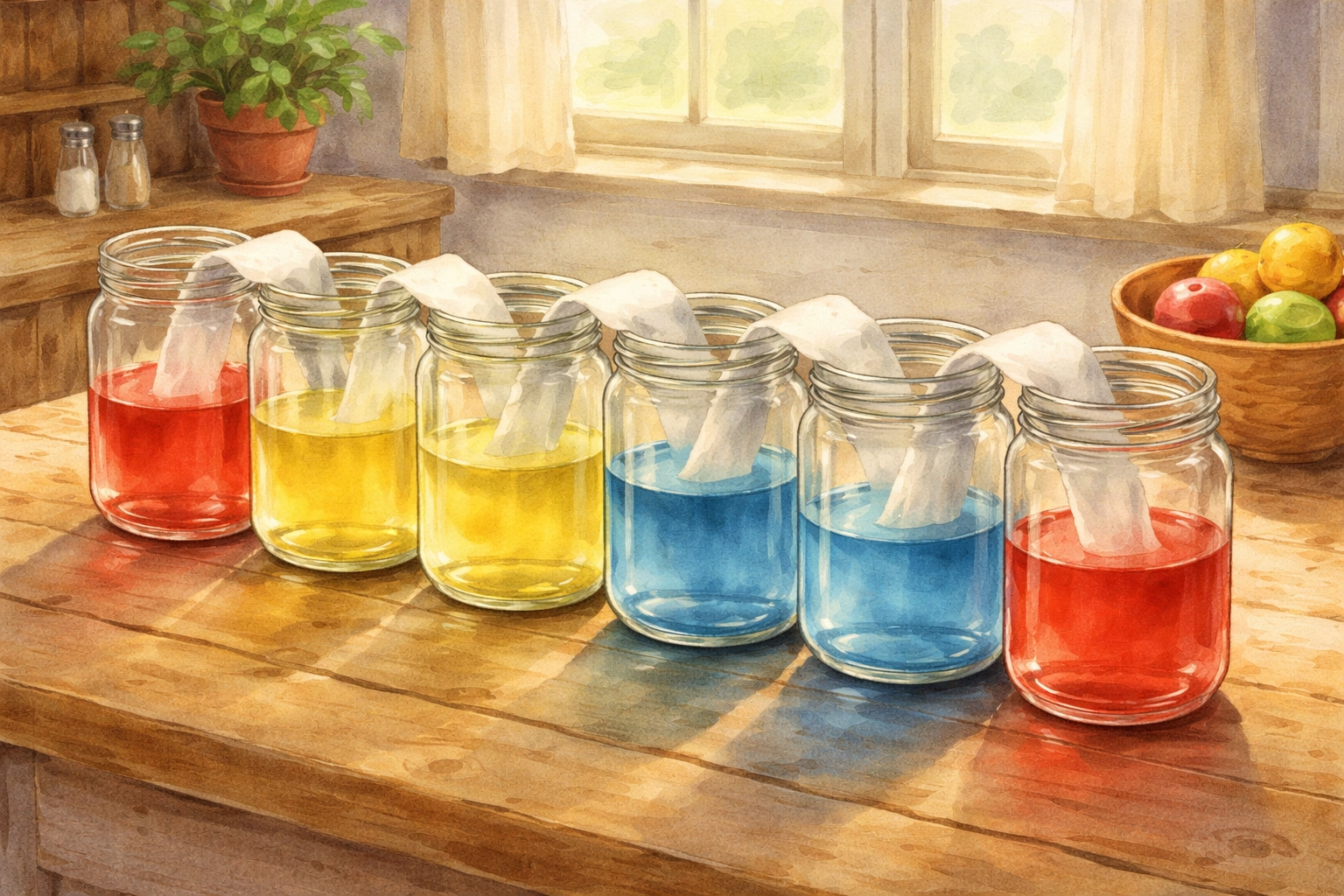
Line up seven clear cups in a row. You want them close enough that a folded paper towel can bridge the gap between each cup without stretching too much. If cups are too far apart, the paper towel may dry out before water can travel across.
Tip for younger kids: Let them help count out the cups and arrange them. This is a great opportunity to practice counting and sequencing.
Step 2: Fill Alternating Cups with Water
Fill cups 1, 3, 5, and 7 with water: roughly three-quarters full works well for most cup sizes. Leave cups 2, 4, and 6 empty. These empty cups are where the color-mixing magic will happen.
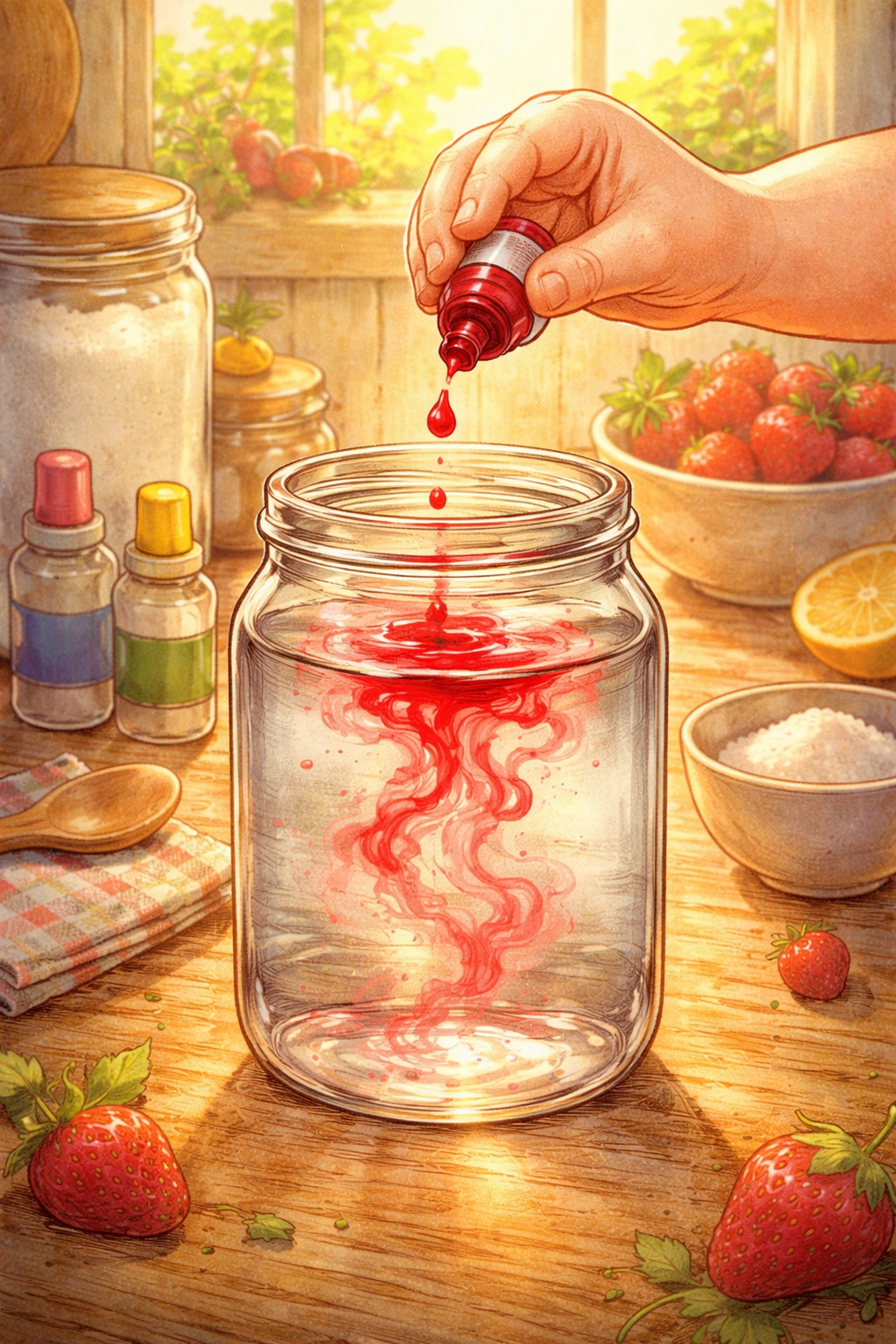
Step 3: Add Food Coloring
Add food coloring to the water-filled cups:
- Cup 1: Red (5–10 drops)
- Cup 3: Yellow (5–10 drops)
- Cup 5: Blue (5–10 drops)
- Cup 7: Red (5–10 drops)
You can adjust the number of drops based on how vibrant you want the colors. More drops typically means more saturated colors in your final result.
Step 4: Fold and Place Paper Towels
Fold six paper towels lengthwise so they're narrow enough to fit into the cups without bunching up too much. Each folded paper towel should be long enough to reach from the bottom of one cup to the bottom of the next.
Place one end of a paper towel into cup 1 and the other end into cup 2. Continue connecting each cup to the next until all seven cups are linked by paper towel bridges.
Step 5: Watch and Wait
Here's where patience comes in. The colored water will begin traveling up and through the paper towels almost immediately, but visible color mixing in the empty cups can take anywhere from 30 minutes to 2 hours: sometimes even longer.
What to do while you wait:
- Check in every 15–20 minutes to observe progress
- Take photos at different stages to compare later
- Encourage your child to make predictions about what colors will appear in the empty cups
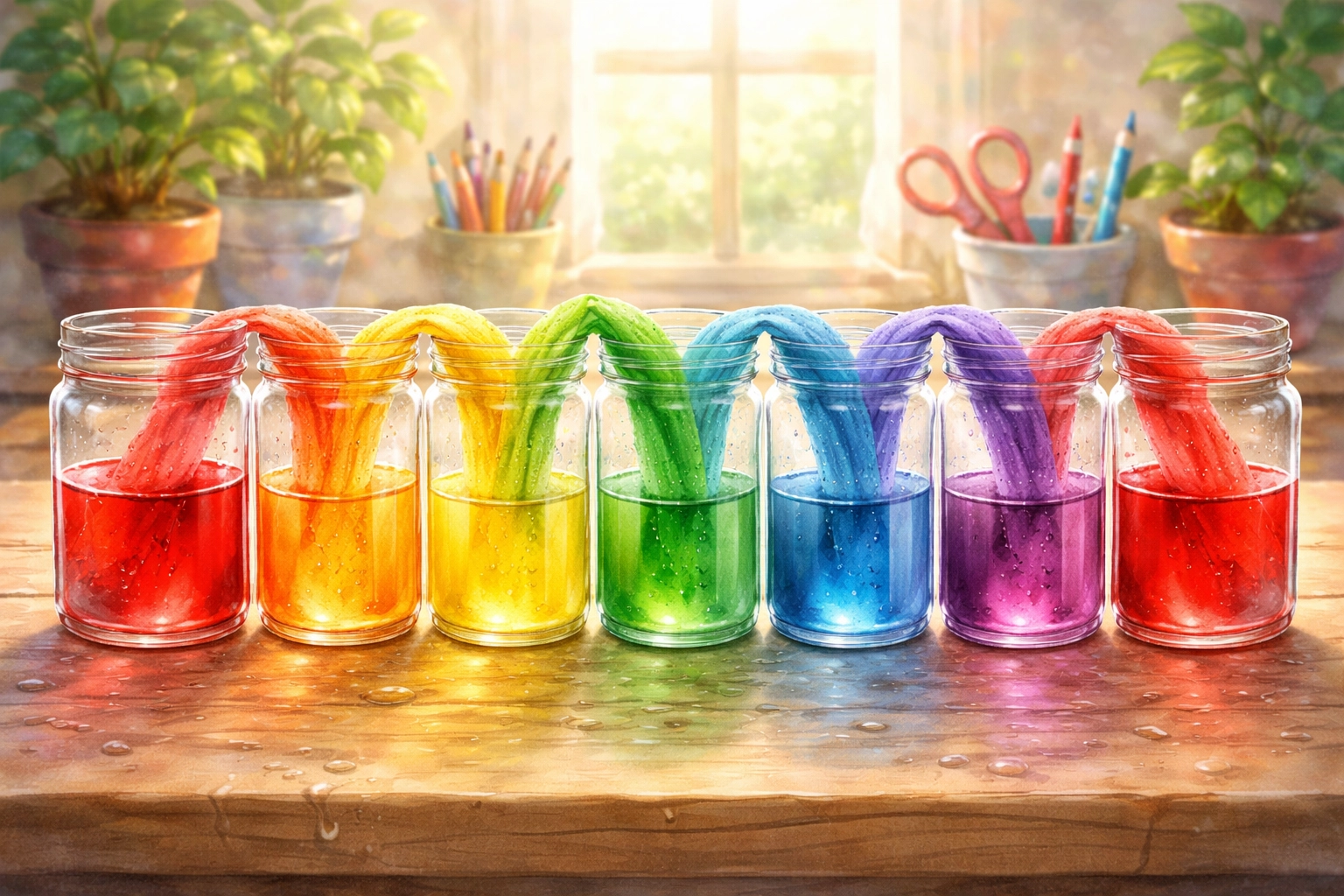
Step 6: Observe the Results
Once the experiment has run its course, you should see:
- Cup 2: Orange (from red + yellow mixing)
- Cup 4: Green (from yellow + blue mixing)
- Cup 6: Purple (from blue + red mixing)
The water levels may also even out across the cups as water continues moving through the paper towels.
The Science Behind the Magic
What Is Capillary Action?
Capillary action is what allows water to move through narrow spaces: even against gravity. Paper towels are made from cellulose fibers, and between those fibers are tiny gaps that act like microscopic tubes.
Two forces work together to make this happen:
Adhesion: Water molecules are attracted to the cellulose fibers in the paper towel. They essentially "stick" to the material.
Cohesion: Water molecules are also attracted to each other. As some molecules stick to the fibers and move upward, they pull other water molecules along with them.
These combined forces are strong enough to pull water upward through the paper towel: at least until the weight of the accumulated water becomes too heavy for adhesion and cohesion to overcome. That's when the upward movement stops and you'll notice the water levels evening out.
Why Do Colors Mix in the Cups, Not the Towels?
This is a detail that surprises many parents. The colors actually mix in the destination cups (the empty ones), not inside the paper towels themselves. As colored water from two different source cups travels into the same empty cup, the colors combine there to create secondary colors.
Tips for Success
Choose your paper towels wisely. Different brands have different fiber densities. Thicker, more absorbent paper towels may take longer but often produce clearer results. Thinner towels may work faster but could tear more easily.
Use clear containers. Being able to see the water levels and color changes from the side makes the experiment much more engaging for kids.
Set up on a tray. Spills happen, especially with younger children involved. A baking sheet or large tray underneath your cups can save your table or countertop.
Be patient with the timeline. If you've read elsewhere that this takes 15 minutes, know that your experience may vary. Temperature, humidity, paper towel brand, and cup spacing can all affect timing.
Variations to Try
Once you've done the basic experiment, here are some ways to extend the learning:
- Test different paper towel brands and compare how quickly water travels through each
- Try different liquids (does it work the same with milk or juice?)
- Experiment with cup spacing to see how distance affects the speed
- Use only two colors to focus on one specific color combination
What Kids Learn
Beyond the fun of watching colors appear like magic, this experiment introduces several concepts:
- Capillary action and how water moves through materials
- Color theory and how primary colors combine to make secondary colors
- Prediction and observation skills
- Patience (a valuable life skill!)
This is also a wonderful activity to connect to real-world examples. You can talk about how plants use capillary action to pull water from their roots up to their leaves, or how a paper towel soaks up spills from a counter.
Looking for more hands-on science activities? Check out our guide on how to make a DIY mini greenhouse out of plastic bottles or explore worm composting with children for another budget-friendly project the whole family can enjoy.
FAQ
- Which colors work best for the color walk? Stick to the primary colors: red, yellow, and blue. When the "walk" is complete, you'll see them mix to create the secondary colors: orange, green, and purple.
- How long does it take for the colors to move? You'll see the water start to move up the paper towels almost immediately, but it usually takes about 2–4 hours for the colors to fully "walk" into the empty jars and mix.
- What kind of paper towels should I use? Thick, absorbent paper towels work best. Generic or very thin brands might not have enough "wicking" power to pull the water all the way up and over into the next jar.
References
- Research on capillary action in paper towel experiments, explaining adhesion, cohesion, and cellulose fiber mechanics.
- Color theory principles regarding primary and secondary color mixing.