




What Does EC Mean in Hydroponics?
EC (Electrical Conductivity) measures the salt content in your water, which tells you how much "food" is dissolved in it. When you add hydroponic nutrients to water, those nutrients break down into tiny charged particles called ions. The more ions floating around, the easier electricity can travel through the water, and the higher your EC reading climbs.
Think of it like this: pure water is a terrible conductor of electricity. But water full of dissolved plant food? That's a superhighway for electrical current. Your EC meter measures how fast that current can travel, and that tells you how much food is waiting for your plants.
The Invisible Food Problem
Here's the thing about hydroponic nutrients: you can't see them.
When you mix that blue or purple liquid into your reservoir, it dissolves completely. The water might turn a little tinted, but you can't actually see the nitrogen, potassium, calcium, or magnesium floating around in there. You can't count the molecules. You can't taste-test it (please don't).
So how do you know if your lettuce has enough food? Or too much? Or if your reservoir is basically just expensive colored water?
You use electricity to count what your eyes can't see.

How EC Meters Actually Work
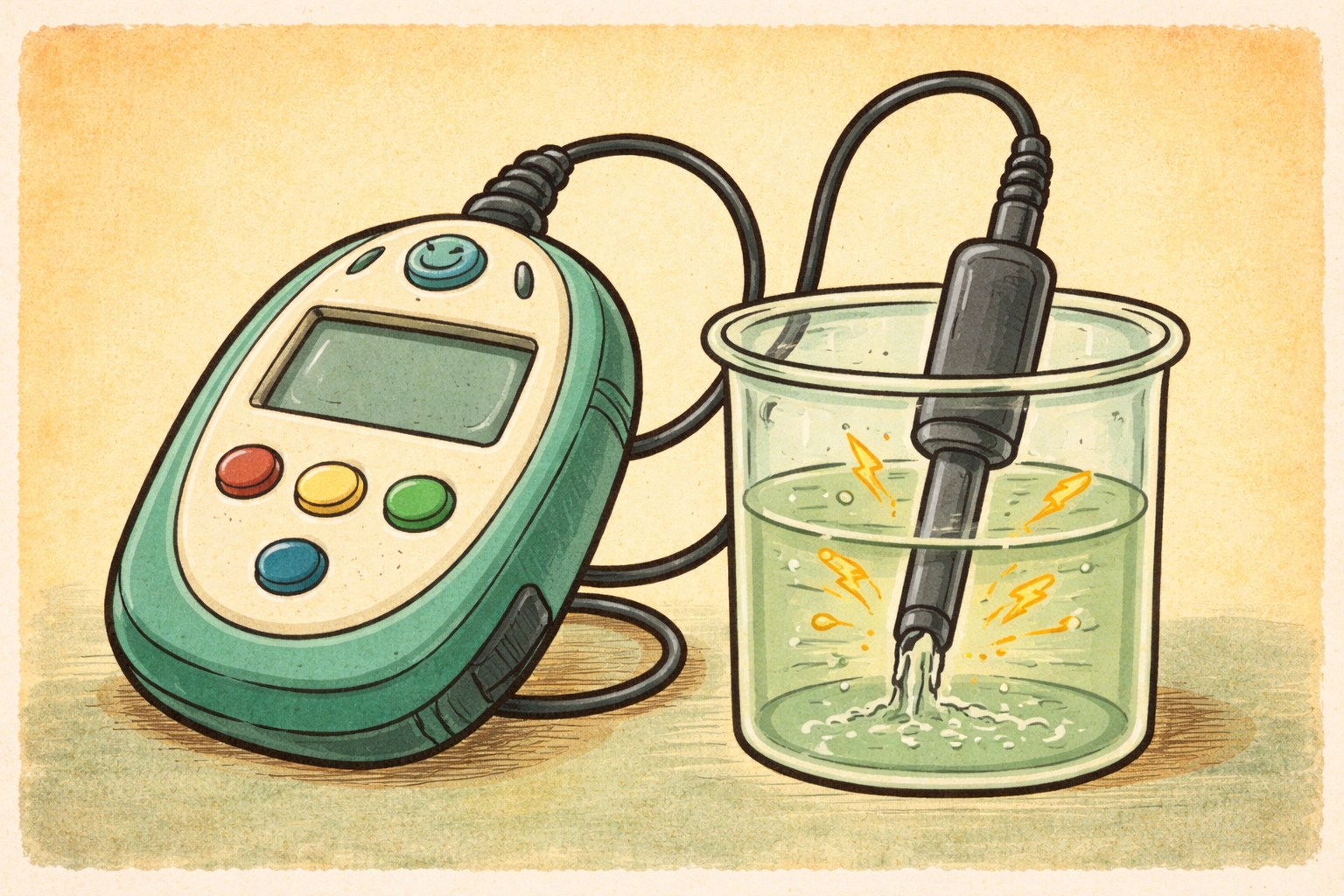
An EC meter is a beautifully simple tool. Inside the probe are two small electrodes: think of them as two tiny metal fingers that dip into your water. The meter sends a small electrical current from one electrode to the other and measures how easily that current travels.
Here's where chemistry gets fun:
- Pure distilled water = Almost no conductivity (no dissolved stuff to carry the current)
- Tap water = Some conductivity (minerals from pipes and treatment)
- Nutrient solution = High conductivity (all that plant food creates a superhighway for electrons)
The meter displays this conductivity as a number, usually in millisiemens per centimeter (mS/cm) or microsiemens per centimeter (µS/cm). Don't let the units scare you: they're just measuring how "easy" it is for electricity to flow.
Most hydroponic EC readings fall between 0.5 and 3.0 mS/cm, depending on what you're growing.
Wait, What About TDS and PPM?
You'll also hear people talk about TDS (Total Dissolved Solids) measured in PPM (Parts Per Million). This sounds completely different from EC, but here's the secret:
TDS meters are just EC meters wearing a disguise.
A TDS meter measures electrical conductivity and then uses a mathematical formula to estimate how many dissolved solids are in the water. It's not actually counting molecules: it's making an educated guess based on how well the water conducts electricity.
The conversion looks something like this:
TDS (ppm) = EC (µS/cm) × Conversion Factor
That conversion factor typically ranges from 0.5 to 0.7, depending on the meter and the type of dissolved solids. This is why two different TDS meters can give you slightly different PPM readings for the same water sample: they might be using different conversion factors.
For most home hydroponic growers, EC is more reliable and consistent. But if your meter reads in PPM, that works too. Just know that you're still measuring conductivity under the hood.
Why Your Plants Care About These Numbers
Plants are picky eaters with very specific preferences.
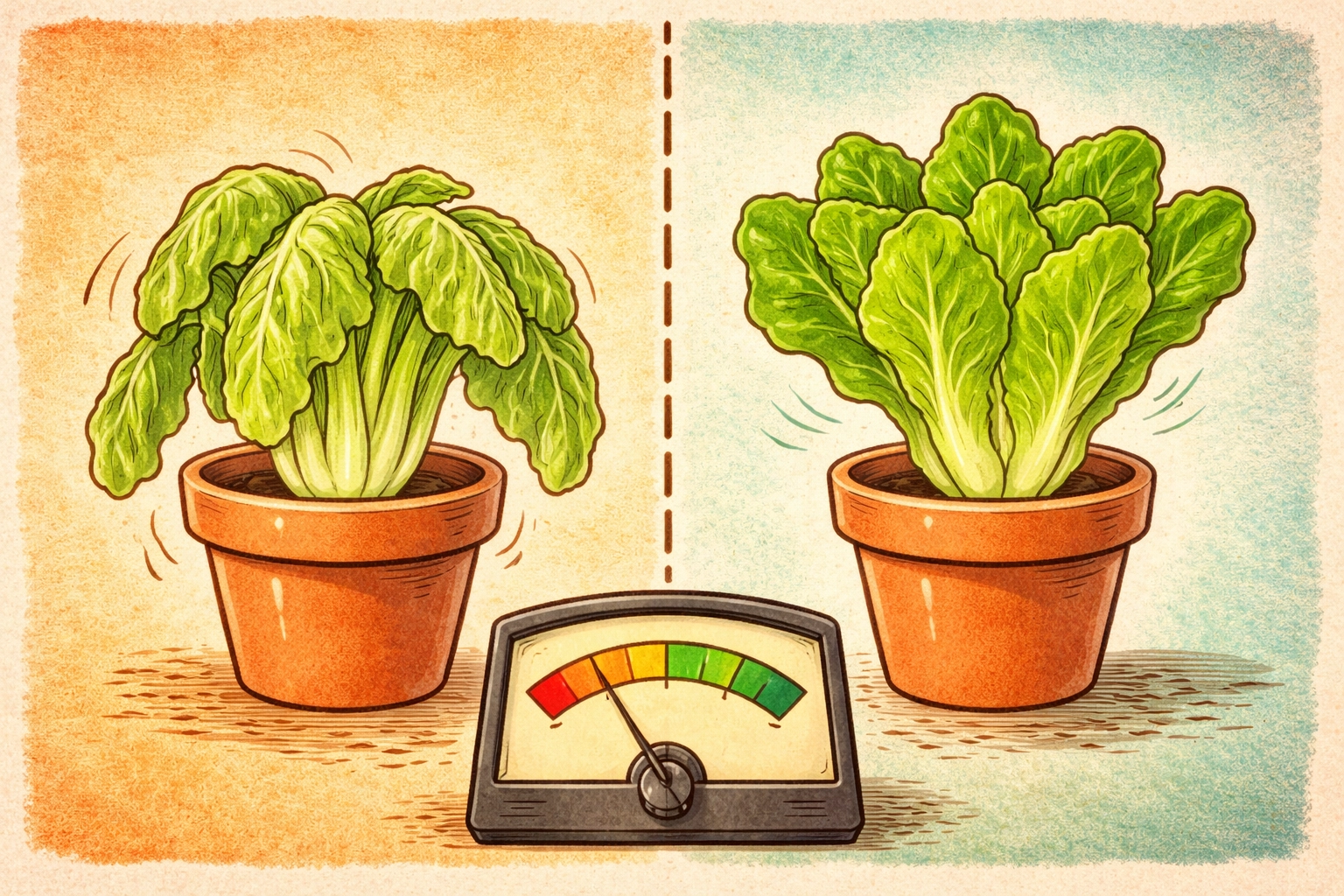
Too little dissolved nutrients (low EC), and your plants starve. They'll grow slowly, look pale, and produce disappointing harvests.
Too much dissolved nutrients (high EC), and you create a different problem. Remember osmosis from our earlier posts? When the water outside the roots has more dissolved stuff than the water inside the roots, the plant struggles to drink. In extreme cases, water actually gets pulled out of the roots. This is called nutrient burn, and it shows up as brown, crispy leaf edges.
The goal is finding the sweet spot: enough food to fuel growth, but not so much that you're overwhelming the system.
The Numbers That Matter: Lettuce and Basil
Different plants prefer different EC ranges. Here are two common ones for beginners:
| Plant | Ideal EC Range | Notes |
|---|---|---|
| Lettuce | 1.2 – 1.8 mS/cm | Prefers the lower end when young |
| Basil | 1.0 – 1.6 mS/cm | Can handle slightly lower EC than lettuce |
These ranges come from research by Purdue University Extension (HO-309-W) and Oklahoma State University (FACT-150-1). They're not absolute laws: your specific setup, water quality, and plant variety might push you slightly higher or lower. But they're excellent starting points.
Junior Engineer Tip: Start at the lower end of the range when your seedlings are small. As the plants grow bigger and hungrier, you can gradually increase the nutrient concentration.
How to Measure EC at Home
You'll need an EC meter (also called a conductivity meter). Basic models cost between $15 and $40 and work perfectly well for home systems. Here's the process:
Step 1: Calibrate Your Meter
Before your first use (and periodically after), calibrate using a standard solution with a known EC value. Most meters come with calibration packets. This ensures your readings are accurate.
Step 2: Mix and Wait
After adding nutrients to your reservoir, stir thoroughly. Let the solution mix completely: you want a representative sample, not a concentrated pocket.
Step 3: Dip and Read
Turn on your meter, dip the probe into the solution, and wait for the reading to stabilize. Most meters take 5-15 seconds to settle on a final number.
Step 4: Record Your Data
Write down the reading along with the date. Tracking EC over time helps you spot patterns: like how quickly your plants are eating, or whether your water is evaporating faster than the nutrients are being consumed.
Temperature Matters (Again!)
Just like dissolved oxygen, electrical conductivity is affected by temperature.
Warmer water conducts electricity more easily than cold water, so a nutrient solution at 80°F will read higher than the same solution at 65°F: even though the actual nutrient content is identical.
Good EC meters include automatic temperature compensation (ATC), which adjusts the reading based on the water temperature. If your meter doesn't have ATC, you'll need to either measure at a consistent temperature or apply a manual correction factor.
This is another reason to keep your reservoir temperature stable in the 65-72°F range. Consistent temperatures mean consistent readings mean fewer headaches.
Frequently Asked Questions
Can I use a TDS meter instead of an EC meter?
Yes! TDS meters measure the same thing (conductivity) and convert to PPM. Just know that PPM readings can vary between meters due to different conversion factors. If possible, note which conversion factor your meter uses (usually 0.5 or 0.7).
How often should I check EC?
For beginners, check daily until you understand how quickly your system changes. Once you have a feel for it, every 2-3 days is usually sufficient for small home systems.
My EC keeps rising: what's happening?
This usually means your plants are drinking more water than they're eating nutrients. The water evaporates or gets absorbed, but the salts stay behind and concentrate. Top off with plain pH-adjusted water to bring the EC back down.
My EC keeps dropping: what's happening?
Your plants are eating faster than they're drinking! This is common with fast-growing, hungry plants. Add more nutrient solution to bring the EC back up.
Do I need an expensive meter?
Not for home use. A $20-30 meter with ATC will serve most beginners perfectly well. Calibrate it regularly and replace it when readings become inconsistent.
Linda's Disclaimer
Linda here! The information in this post is for educational purposes to help families learn together. Electrical conductivity measurements are guides, not guarantees. Every hydroponic system is a little different, and your plants are the ultimate judges of whether they're happy. Always supervise children around water and electrical equipment, and remember that the real learning happens through observation and experimentation. When in doubt, start conservative and adjust based on what your plants tell you!
References
- Purdue University Extension. "Hydroponic Vegetable Production." Publication HO-309-W.
- Oklahoma State University. "Electrical Conductivity and pH Guide for Hydroponics." FACT-150-1.
- University of Arizona Controlled Environment Agriculture Center. "Measuring Nutrient Solution EC and pH."
Next up in our Junior Engineer series: we're putting together everything we've learned about pH, nutrients, oxygen, and EC into a complete system checkup guide. Get your lab notebooks ready! 🔬📊🌱